
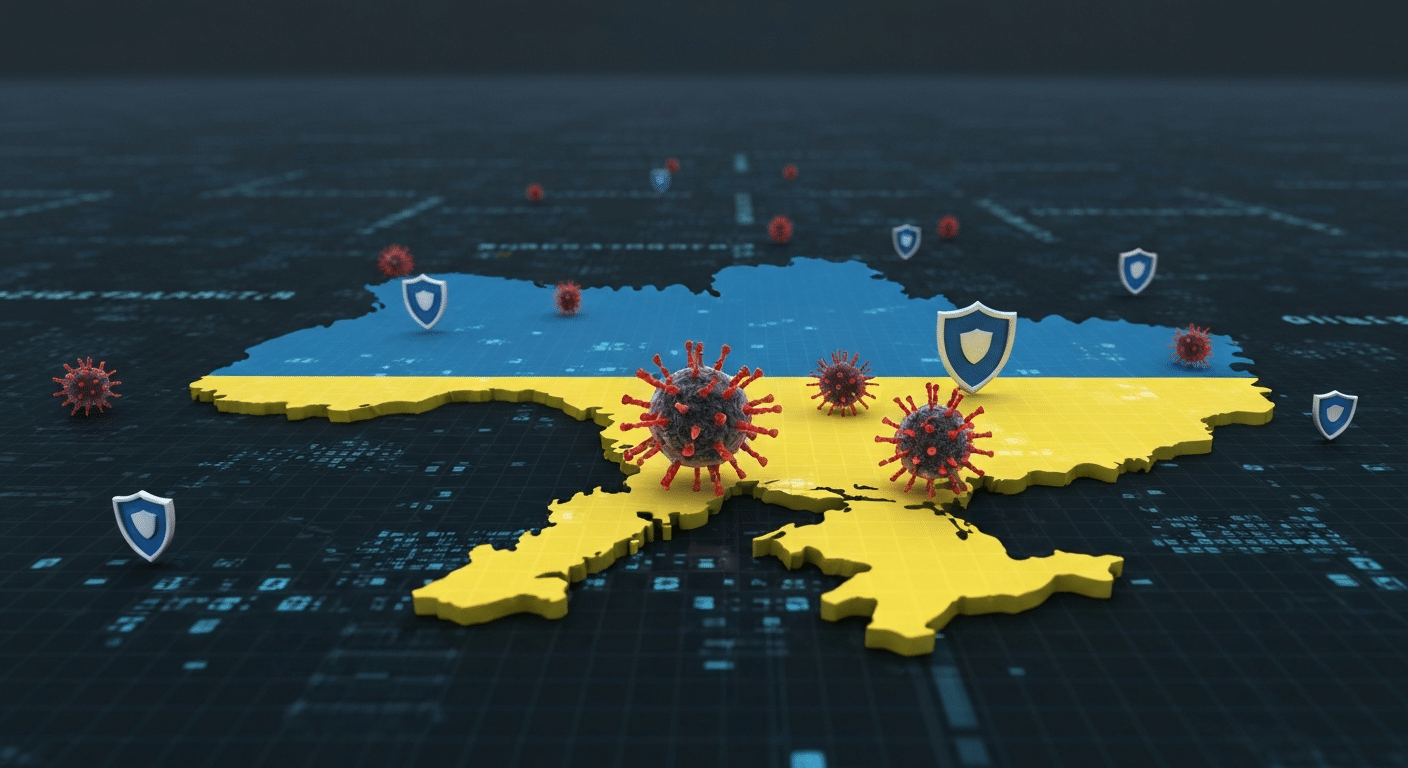
A new cyber threat has emerged, targeting the digital infrastructure of Ukraine. This threat comes in the form of the CANFAIL malware, deployed by a previously unknown threat actor. According to Google Threat Intelligence, this group’s activities show a sustained and multifaceted cyber pressure campaign. The operations are primarily aimed at Ukrainian organizations, with evidence suggesting a connection to Russian state-sponsored groups. This blog will explore the details of the CANFAIL malware, its origins, and its impact on the ongoing cyber conflict.
Overview of CANFAIL Malware
The CANFAIL malware represents a significant development in the cyber operations targeting Ukraine. It is an obfuscated JavaScript malware delivered through carefully crafted phishing campaigns. A previously undocumented threat actor, believed to have ties to Russian intelligence services, is behind these malware attacks.
According to the Google Threat Intelligence Group, this group, while less resourced than other Russian threat actors, has started using advanced AI tools to enhance its capabilities. We will now examine what makes CANFAIL unique, its evolution, and its importance in today’s threat landscape.
Defining CANFAIL: What Makes It Distinctive?
CANFAIL is an obfuscated JavaScript malware designed with a specific purpose: to infiltrate systems and execute a secondary payload. What sets it apart is its delivery method and the actor behind it. A previously undocumented threat actor uses sophisticated social engineering techniques to trick victims into downloading it. The malware is often disguised with a double extension, such as “*.pdf.js,” to appear as a legitimate document.
Once executed, CANFAIL runs a PowerShell script that downloads and executes a memory-only dropper. This technique allows the malware to operate stealthily, often without leaving a trace on the victim’s hard drive. Simultaneously, it displays a fake “error” message to the user, a deceptive tactic to mask its malicious activity.
This combination of social engineering, obfuscation, and memory-only execution makes CANFAIL a tricky threat to detect and mitigate. The unique techniques employed by this emerging threat actor highlight a shift in tactics, even among less-resourced groups.
Evolution of CANFAIL Malware Attacks
The malware attacks involving CANFAIL have shown a clear progression in sophistication and targeting. While the threat actor is relatively new on the scene, its activities have been traced back through historical campaigns. The earliest observed compromises indicate a focused effort on specific sectors within Ukraine. Initially, the group’s operations were less refined, but they have adapted over time.
One notable campaign linked to this actor is “PhantomCaptcha,” which targeted organizations involved in Ukraine’s war relief efforts. This campaign used phishing emails with “ClickFix-style” instructions to initiate the infection sequence, ultimately delivering a WebSocket-based trojan. This shows the actor’s willingness to experiment with different delivery mechanisms.
More recent operations have seen the actor impersonating legitimate Ukrainian and Romanian energy companies. They generate tailored email lists for specific regions and industries, demonstrating a more strategic approach to their malware attacks and increasing their chances of success.
Importance of Studying CANFAIL in the Modern Threat Landscape
Understanding the CANFAIL malware is crucial for navigating the modern threat landscape. This particular threat highlights how even less-resourced actors can pose a significant danger, especially when they begin to leverage new technologies like large language models (LLMs). Google Threat Intelligence has noted that these actors are using AI to overcome technical limitations, which is a worrying trend.
Studying CANFAIL provides valuable insights into the evolving tactics of state-sponsored groups. The focus on Ukraine’s defense industrial base reveals the strategic objectives behind these cyber operations. By analyzing their methods, security professionals can better anticipate and defend against similar attacks.
The key takeaways for the industry today include:
- The growing use of AI by threat actors for reconnaissance and social engineering.
- The continued targeting of critical infrastructure and supply chains.
- The importance of employee education to recognize and avoid sophisticated phishing lures, which are some of the leading threats.
Origins and Attribution of CANFAIL Attacks
The origins of the CANFAIL malware attacks point strongly toward a threat actor with connections to Russian intelligence services. Although the group was previously undocumented, its tactics and targets align with the strategic interests of other known Russian threat groups. The actor has focused its efforts on Ukrainian military, government, and energy organizations.
This pattern of targeting, combined with the use of hacktivist groups for disruptive operations like data leaks, complicates attribution but fits a known playbook. The following sections will explore the evidence linking the actor to Russia, the timeline of attacks, and the profile of the individuals behind CANFAIL.
Evidence of Russian Involvement in CANFAIL Operations
Several pieces of evidence connect the CANFAIL malware operations to a Russian actor. The Google Threat Intelligence Group assesses that the hack group is “possibly affiliated with Russian intelligence services.” This assessment is based on the actor’s specific targeting choices, which align with Moscow’s strategic objectives in the ongoing conflict with Ukraine.
The group has consistently targeted Ukrainian defense, military, and government entities, which is a hallmark of Russian state-sponsored cyber espionage. Furthermore, the actor’s focus on energy organizations in Ukraine, Romania, and Moldova reflects a broader Russian strategy to destabilize the region’s energy sector.
While direct attribution is challenging, the operational patterns are consistent with other known Russian campaigns. The use of leak operations and the alignment of targeting with geopolitical goals provide strong circumstantial evidence of a Russian actor’s involvement, even if their technical sophistication is lower than that of other established Russian groups.
Timeline of Attacks Targeting Ukraine
The timeline of malware attacks deploying CANFAIL shows a focused and escalating campaign against Ukrainian targets. The earliest observed compromises began with broad-spectrum phishing but quickly evolved. Historical campaigns demonstrate a learning curve, with the threat actor refining its techniques over time.
A notable campaign, “PhantomCaptcha,” was first detailed in October 2025 by SentinelLABS. This operation targeted organizations associated with Ukraine’s war relief efforts. More recent activities have shown the actor impersonating energy companies to gain access to corporate and personal email accounts.
This timeline indicates a persistent effort to infiltrate various sectors of Ukrainian society. The attacks have become more targeted, moving from general phishing to industry-specific lures.
| Date/Period | Activity Description | Target Sector |
|---|---|---|
| October 2025 | “PhantomCaptcha” campaign disclosed, using ClickFix-style social engineering. | War relief organizations |
| Late 2025 | Impersonation of national and local Ukrainian energy organizations. | Energy, Government |
| Early 2026 | Targeting of a Romanian energy company and reconnaissance on Moldovan organizations. | Energy, Aerospace |
Profile of Threat Actors Behind CANFAIL
The group behind CANFAIL is described as a previously undocumented threat actor, distinct from other well-known Russian hacking collectives. What makes this threat actor interesting is their resourcefulness despite being less sophisticated than groups like APT44 (Sandworm). They compensate for technical limitations by using publicly available tools and, more recently, large language models (LLMs).
This actor appears to be a smaller, more agile unit, possibly operating with some degree of autonomy while aligning with broader state objectives. Their profile is not that of elite cybercriminals or criminal groups focused on monetary gain, but rather one of espionage and disruption. They conduct thorough reconnaissance to create highly specific target lists and customized phishing lures.
The group’s activities blend elements of traditional cyber espionage with tactics seen among hacktivist groups, such as a focus on specific geopolitical themes. This hybrid approach allows them to fly under the radar while still achieving strategic goals, making them a persistent and unpredictable threat.
Technical Analysis of CANFAIL Malware
A technical look at the CANFAIL malware reveals a multi-stage infection process designed for stealth and effectiveness. The initial access is typically gained through phishing emails containing malicious links. The malware itself is an obfuscated JavaScript file that exploits user trust to execute its payload.
Once running, it leverages PowerShell to download additional components, often operating entirely in memory to evade detection. This section will break down the main exploits and vulnerabilities used, the common attack vectors, and the capabilities of the malware’s payload.
Main Exploits and Vulnerabilities Utilized
The CANFAIL malware does not rely on sophisticated zero-day exploits. Instead, its success hinges on exploiting human behavior and system misconfigurations. The primary vulnerability it targets is the user’s willingness to open documents from seemingly trusted sources. Initial access is gained when a user clicks a malicious Google Drive link and executes the disguised JavaScript file.
The malware’s design takes advantage of how operating systems handle file extensions. By using a double extension like “.pdf.js,” the threat actor tricks the user into thinking they are opening a simple PDF document, when in fact they are running a script. This bypasses many basic security warnings.
Rather than exploiting specific software vulnerabilities, CANFAIL leverages legitimate access pathways and system tools like PowerShell. This “living off the land” technique makes its activity harder to distinguish from normal administrative tasks, allowing it to persist undetected within a network.
Attack Vectors: How CANFAIL Infiltrates Systems
The primary attack vectors for CANFAIL are social engineering and phishing. The threat actor conducts detailed reconnaissance to craft convincing lures tailored to their targets. For instance, they have been observed impersonating recruitment portals and sending fake job offers to individuals working in the defense and aerospace sectors.
These campaigns often involve spoofed job portals and fake job descriptions from well-known defense companies. The goal is to trick employees into providing credentials or downloading malicious files disguised as application materials. This exploitation of the hiring process is a key theme in their operations.
Common infiltration methods include:
- Phishing emails with Google Drive links hosting the malware.
- Lures themed around industry events, training courses, or job opportunities.
- Direct targeting of employees’ personal email accounts, which often have fewer security protections than corporate ones.
Malware Payload and Capabilities
The CANFAIL malware payload is delivered in stages to maximize evasion. The initial JavaScript file is primarily a downloader. Its main function is to execute a PowerShell script that fetches the next stage of the attack, which is typically a memory-only PowerShell dropper. This means of initial access ensures that the core malicious code is never written to the disk, making forensic analysis difficult.
Once the final payload is active, its capabilities are focused on espionage and data exfiltration. The malware can collect sensitive data from the compromised system, including documents, credentials, and other intellectual property. In some cases, it can establish a persistent backdoor for long-term access.
The ultimate goal of these data breaches is to steal information that supports the threat actor’s strategic objectives. This could include defense technologies, military plans, or intelligence that provides a battlefield advantage, leading to significant national security risks.
Impact on Ukraine’s Digital Infrastructure
The CANFAIL malware campaigns have had a tangible impact on Ukraine’s digital infrastructure. By targeting critical sectors, the threat actor aims to cause disruption and gather intelligence. The sustained pressure on the defense industrial base, energy organizations, and government agencies creates a significant risk of data breaches and operational interruptions.
This disruption of the manufacturing base and other key areas could weaken Ukraine’s defense capabilities and impact its national security. The following sections will detail the specific sectors affected, provide examples of breaches, and discuss the potential long-term consequences.
Sectors Affected by CANFAIL
The CANFAIL malware has been deployed against a wide range of strategic sectors in Ukraine. The primary targets reflect the threat actor’s intelligence-gathering priorities, which are closely tied to the ongoing conflict. The group has shown a clear focus on organizations that are critical to Ukraine’s war effort and national stability.
The actor’s targeting has evolved, starting with broad government and military entities and then narrowing to more specific and high-value targets. This strategic selection indicates a well-defined set of objectives aimed at undermining Ukraine’s defense capabilities and industrial capacity.
Key sectors affected by CANFAIL include:
- The defense industrial base, including companies involved with unmanned aircraft systems (UAS) and other military technologies.
- Government and military organizations at both the national and regional levels.
- Local Ukrainian energy organizations, as well as related companies in neighboring countries like Romania and Moldova.
Case Studies of Successful Breaches
While specific details of every breach are not always public, reports from Google Threat Intelligence and other security firms confirm successful infiltrations. One documented case involves the “PhantomCaptcha” campaign, which successfully compromised organizations involved in war relief efforts. This breach allowed the actor to deliver a trojan capable of exfiltrating sensitive data and maintaining persistence.
Another example is the series of phishing operations targeting Ukrainian energy organizations. The threat actor masqueraded as legitimate energy companies to gain unauthorized access to organizational and personal email accounts. These data breaches likely resulted in the theft of sensitive communications and operational details, disrupting business operations.
These successful attacks on military organizations and critical infrastructure highlight the effectiveness of the actor’s social engineering techniques. Even without using highly advanced exploits, they have managed to breach networks and access valuable information, demonstrating the significant risk posed by this malware.
Potential Consequences for National Security
The consequences of CANFAIL attacks for Ukraine’s national security are severe. The theft of sensitive information from the defense sector can lead to a significant loss of intellectual property. This includes designs for defense technologies, battlefield management systems, and unmanned aircraft systems, which could be reverse-engineered or countered by adversaries.
Compromising military and government networks also provides the threat actor with valuable intelligence on troop movements, operational plans, and communication protocols. This information can be used to gain a tactical advantage on the battlefield. The disruption of critical infrastructure, such as the energy grid, can create widespread chaos and undermine public confidence.
Ultimately, these cyber operations are part of a broader hybrid warfare strategy. By weakening Ukraine’s industrial capacity and stealing its defense secrets, the actor aims to erode the nation’s ability to defend itself. The long-term impact on national security could be profound, affecting both the current conflict and future defense capabilities.
Exploring the Term “CanFail” in Technology & Coding
Beyond its use as a malware name, the term “CanFail” has a distinct meaning in the world of software development and technology. In this context, “CanFail” is not a threat but a concept used to describe functions or operations that have the potential to fail. It is often used as a marker or argument in functional programming to signal that a piece of code may not execute successfully.
This concept is crucial for writing robust and reliable software. Understanding how to handle “CanFail” scenarios is a key skill for developers. Let’s look at the “CanFail” argument, how to document such functions, and lessons from its use in frameworks like ZIO.
The CanFail Argument in Software Development
In software development, the “CanFail” argument is a convention used to explicitly indicate that a function might not return the expected result. It serves as a warning to other developers that they need to implement error-handling logic when using that function. This is particularly common in languages and frameworks that emphasize functional programming principles, where managing side effects and potential failures is a core concern.
By marking a function with a “CanFail” argument or a similar construct, developers improve code quality and readability. It makes the code more predictable and prevents unexpected crashes when an operation fails, such as a network request timing out or a file not being found.
This practice encourages a proactive approach to error handling. Instead of letting an application crash, developers can gracefully manage the failure, perhaps by retrying the operation, logging the error, or notifying the user. It is a fundamental part of building resilient and user-friendly software.
Documenting Functions That Can Fail
Properly documenting functions that can fail is essential for team collaboration and long-term code maintenance. When a function is marked as “CanFail,” its documentation should clearly explain the conditions under which it might fail and what kind of error or exception it will return. This allows other developers to use the function correctly without having to read through its entire source code.
Good documentation includes a description of the function’s purpose, its parameters, its expected return value on success, and the possible failure outcomes. For instance, the documentation might state, “This function can fail if the network connection is unavailable, in which case it will return a ‘NetworkError’ object.”
This level of detail in documenting code is crucial for preventing vulnerabilities. When error conditions are not handled properly, it can lead to security loopholes that attackers might exploit. Clear documentation ensures that potential failures are accounted for, making the overall application more secure and robust.
Lessons from ZIO’s CanFail in Functional Programming
ZIO, a popular library for asynchronous and concurrent functional programming in Scala, provides an excellent example of handling “CanFail” scenarios. In ZIO, effects (which represent computations) are typed to show whether they can fail. This is a core part of its design, forcing developers to explicitly deal with potential errors at compile time.
The ZIO framework teaches developers that failure is a normal part of programming, not an exceptional event. By making failure a first-class citizen, ZIO encourages building resilient systems that can gracefully handle errors without crashing. This approach contrasts with traditional exception handling, where errors can often go unnoticed until they cause a problem in production.
Lessons from ZIO’s use of “CanFail” include:
- Explicitness is Key: Making potential failures visible in the type system improves code clarity and safety.
- Composability of Errors: ZIO allows developers to combine and transform error types, making error handling more flexible.
- Resilience by Design: Building software with the assumption that things can and will fail leads to more robust and reliable applications.
Mitigation Strategies and Defense Mechanisms
Defending against threats like the CANFAIL malware requires a multi-layered approach that combines technical controls, employee training, and robust incident response plans. There is no single solution; instead, organizations must adopt a variety of defense mechanisms to protect their systems and data. By implementing best security practices, you can significantly reduce your risk of a successful attack.
This section will cover practical mitigation strategies for protecting your organization, security best practices for developers, and the essential steps for incident response and recovery.
Protecting Organizations Against CANFAIL
To protect against CANFAIL and similar threats, defense organizations and other potential targets must implement comprehensive mitigation strategies. The first line of defense is strengthening email security to filter out phishing attempts. This includes using advanced threat protection services that can scan links and attachments for malicious content.
Employee training is also critical. Since CANFAIL relies on social engineering, educating your staff to recognize suspicious emails, verify links before clicking, and report potential threats can prevent an initial compromise. As noted by Google Threat Intelligence, the human element is often the weakest link.
From a technical standpoint, organizations should:
- Restrict the use of scripting languages like PowerShell where not necessary.
- Implement application whitelisting to prevent unauthorized executables from running.
- Keep all software and systems patched to close any known vulnerabilities that could be chained with a social engineering attack.
Best Security Practices for Developers
Developers play a crucial role in building secure applications that are resilient to attack. Adhering to best security practices during the software development lifecycle can help prevent vulnerabilities that threat actors might exploit. One of the most important practices is input validation. Always treat user input as untrusted and sanitize it to prevent injection attacks.
Writing secure code also means handling errors and exceptions properly. As discussed with the “CanFail” concept, failing to manage potential errors can leave an application in an unstable state, creating opportunities for exploitation. Developers should implement robust error-handling logic and avoid leaking sensitive information in error messages.
Furthermore, developers should follow the principle of least privilege. Ensure that code runs with only the permissions it needs to function. This limits the damage an attacker can do if they manage to compromise a part of the application. Regularly reviewing code for security vulnerabilities is also a key practice.
Incident Response and Recovery Steps
When a security incident like a CANFAIL infection occurs, having a well-defined incident response plan is crucial for minimizing damage and restoring business operations quickly. The first step is containment. Isolate the affected systems from the network to prevent the malware from spreading further. This might involve disconnecting a machine or blocking its network access.
Next, the incident response team needs to identify the scope of the breach. This involves analyzing logs, memory, and network traffic to understand how the attacker got in, what systems were compromised, and what data was accessed. This information is vital for eradication, which involves removing all traces of the malware from the network.
Finally, the recovery phase focuses on restoring the affected systems from clean backups and strengthening defenses to prevent a recurrence. This includes patching any exploited vulnerabilities, updating security policies, and conducting a post-incident review to learn from the event. For Ukrainian institutions, swift and decisive action is key to mitigating the impact of these attacks.
Broader Relevance: Failures in Code, Systems, and AI
The “CanFail” concept extends beyond just malware or a single programming framework. It speaks to a fundamental truth in technology: all systems can fail. From simple code functions to complex AI tools, the potential for error is always present. Understanding and planning for these failures is essential for building resilient and reliable technology that supports business operations.
This section will explore real-world examples of system failures, how advanced AI tools like ChatGPT can fail professionals, and the lessons we can learn from these “CanFail” scenarios.
Real-World Examples of Systems That Can Fail
History is filled with examples of code and systems that failed, often with significant consequences. The Mars Climate Orbiter is a classic case where a simple software error—a mismatch between metric and imperial units—led to the loss of a $125 million spacecraft. This highlights how a small oversight in code can have catastrophic results.
In the business world, system failures can disrupt operations and cause massive financial losses. The 2012 Knight Capital trading glitch, caused by a faulty software deployment, resulted in the company losing $440 million in just 45 minutes. This demonstrates the critical importance of rigorous testing and deployment procedures.
These incidents underscore a universal principle:
- Complexity Increases Risk: The more complex a system is, the more potential points of failure it has.
- Human Error is a Factor: Many system failures can be traced back to human mistakes in design, coding, or operation.
- Testing is Not Optional: Thorough testing is essential for identifying and mitigating potential failures before they impact users.
When ChatGPT and AI Tools Fail Professionals
Even sophisticated AI tools like ChatGPT are not immune to failure. While they are incredibly powerful, they can and do make mistakes. For professionals like lawyers, relying on AI without proper verification can lead to serious problems. For example, there have been documented cases of lawyers submitting legal documents to courts that cited non-existent cases “hallucinated” by an AI.
These AI tools can also produce code that contains security vulnerabilities or is of poor quality. A developer who blindly copies and pastes AI-generated code without understanding it may inadvertently introduce weaknesses into their application. The AI is only as good as the data it was trained on and may not be aware of the latest security best practices.
The lesson here is that AI tools should be seen as assistants, not as infallible experts. Professionals must maintain a critical eye, verify the information AI provides, and take ultimate responsibility for the final output, whether it’s a legal brief or a block of code.
Learning From Common Pitfalls of “CanFail” Scenarios
Learning from “CanFail” scenarios is about adopting a mindset of proactive failure management. One of the most common pitfalls is assuming that an operation will always succeed. This optimistic programming leads to fragile code that breaks easily. The best practice is to assume failure is possible and write code that handles it gracefully.
Another pitfall is inadequate error handling. Simply catching an exception and doing nothing with it is not enough. Proper error handling involves logging the error for later analysis, notifying the user in a helpful way, and attempting to recover if possible. Ignoring errors can hide underlying problems until they cause a major system failure.
To avoid these pitfalls, developers should:
- Embrace Defensive Programming: Write code that protects itself from unexpected inputs and states.
- Use Explicit Error Types: Instead of generic exceptions, use specific error types that convey what went wrong.
- Test Failure Paths: Intentionally test how the code behaves when things go wrong, not just when everything works perfectly.
Social Discussions: #canfail on Social Media
The term “CanFail” has also found its way into social media discussions, often under the hashtag #canfail. While some conversations revolve around its technical meaning in programming, others use it more broadly to discuss system failures, cybersecurity incidents, and the public perception of technological reliability.
These discussions reflect a growing awareness of the vulnerabilities inherent in our digital world. The hashtag has become a space for sharing stories of failures, debating best practices, and raising awareness about ongoing cyber operations.
Key Conversations Shaping Public Perception
On social media platforms, the #canfail hashtag is at the center of several key conversations. Developers and software engineers use it to share tips and frustrations about error handling in code. They discuss different strategies for managing potential failures and debate the merits of various programming languages and frameworks in this regard.
Cybersecurity professionals use #canfail to highlight recent data breaches and vulnerabilities, often linking it to specific threats like the CANFAIL malware. These posts serve to educate the public about the tactics used by threat actors and the importance of good security hygiene.
Beyond the technical community, the hashtag is also used by the general public to comment on service outages, buggy software, and other technological frustrations. These conversations shape public perception by reinforcing the idea that technology is not infallible and that failures are a common, albeit unwelcome, part of modern life.
The Role of Social Media in Cybersecurity Awareness
Social media plays a dual role in cybersecurity awareness. On one hand, it is an incredibly effective tool for disseminating information quickly. Security researchers and agencies can use platforms like Twitter to share alerts about new threats, such as the global resurgence of hacktivism, and provide timely advice on how to stay safe.
Hashtags like #canfail help to amplify these messages, creating a shared space where both experts and the public can engage with the topic. This can lead to a more security-conscious population that is better equipped to recognize and respond to threats like phishing and social engineering.
However, social media is also a breeding ground for misinformation. Threat actors can use these platforms to spread propaganda or create confusion.
- It allows for rapid dissemination of threat intelligence.
- It enables community-driven learning and discussion.
- It requires critical evaluation to separate credible information from noise.
Conclusion
In conclusion, understanding the CANFAIL malware is crucial for safeguarding Ukraine’s digital assets and infrastructure. This deep dive has highlighted its distinctive characteristics, the evolution of its attacks, and the threat actors behind it. As we navigate the complexities of cybersecurity, awareness and preparedness are key to mitigating risks associated with such advanced threats. By implementing best security practices and staying informed about the evolving landscape, organizations can effectively defend against CANFAIL and similar malware. Don’t leave your security to chance; reach out for a free consultation to ensure your systems are equipped to handle these modern challenges.
Frequently Asked Questions
What is the CANFAIL malware and how does it affect organizations?
CANFAIL is an obfuscated JavaScript malware used by a threat actor linked to Russia to target Ukrainian organizations. It is delivered via phishing and is designed to steal sensitive data. It primarily affects the defense sector, government, and energy organizations, leading to data breaches and potential disruptions to operations.
How can developers reduce exposure to CANFAIL vulnerabilities?
Developers can reduce exposure by following best security practices such as validating all user input, implementing robust error handling, and writing code that fails securely. This mitigation approach prevents the exploitation of software vulnerabilities that can be used to deliver malware or gain unauthorized access to systems.
What actions should Ukrainian institutions take against CANFAIL?
Ukrainian institutions should implement a strong incident response plan that includes containing the threat, eradicating the malware, and recovering from backups. For defense, they should enhance email security, train employees to spot phishing, restrict unnecessary scripts, and collaborate with threat intelligence partners to stay ahead of the threat actor.

Zak McGraw, Digital Marketing Manager at Vision Computer Solutions in the Detroit Metro Area, shares tips on MSP services, cybersecurity, and business tech.