
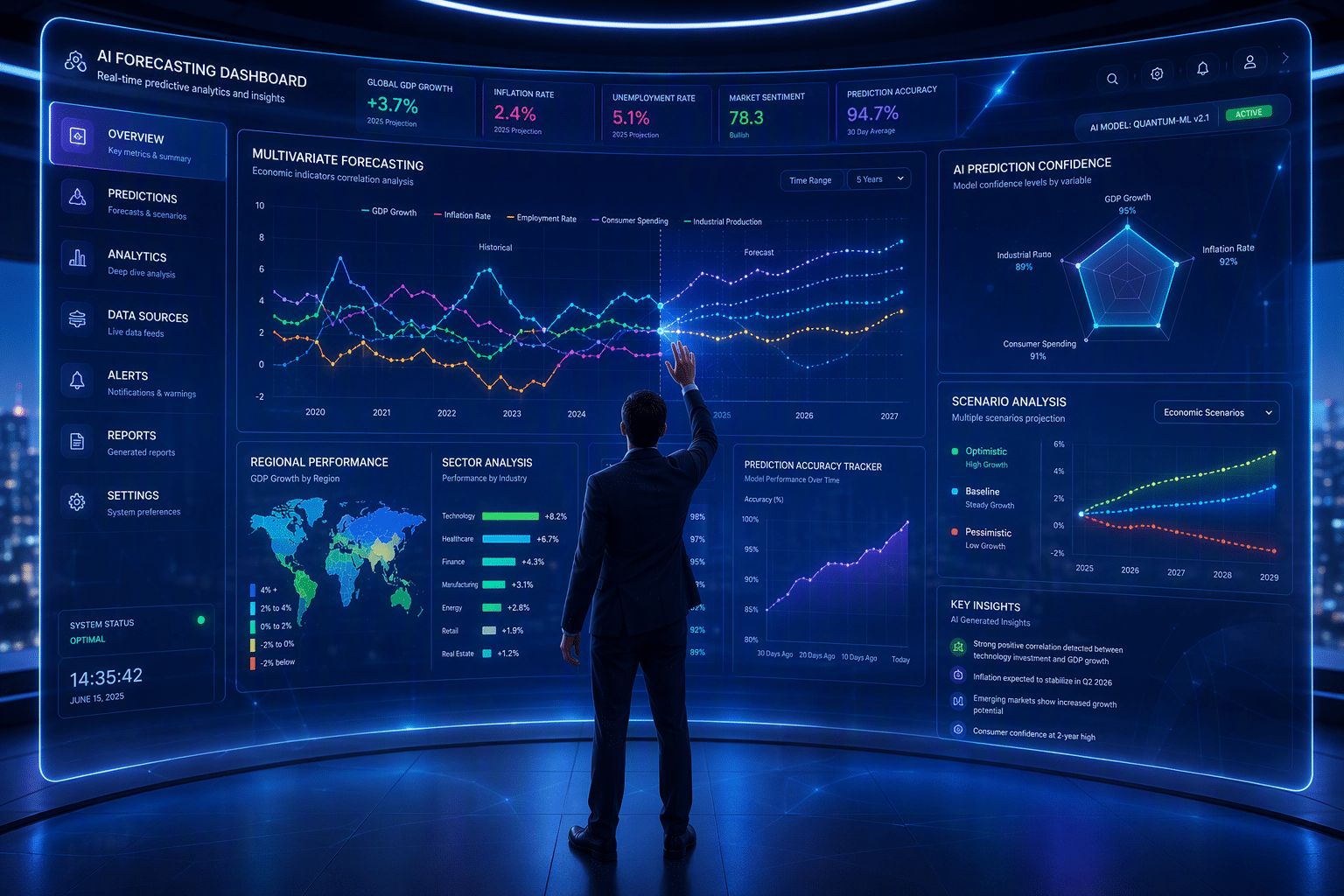
Google Research introduced TimesFM-3 as a new time series foundation model designed for accurate multivariate time series forecasting, not just single-series prediction. That matters because real forecasting often depends on more than a series and its own history. Retail demand, healthcare signals, and finance data all involve related series and external drivers. TimesFM-3 brings those pieces together in a zero-shot setup, helping you forecast multiple targets with known signals such as promotions or weather without task-specific fine-tuning.
Understanding TimesFM-3: Foundations of Efficient Multivariate Forecasting
At its core, TimesFM-3 is a time series foundation model that improves multivariate forecasting by learning from multiple related time series at once. Instead of treating each target separately, it captures links across series and utilizes covariates that shape future outcomes, effectively understanding complex temporal patterns.
What makes it practical is the way it produces forecasts in one forward pass. With zero-shot forecasting, you do not need task-specific fine-tuning. You provide historical sales context plus known future signals, and the model predicts the future horizon directly. To see why that stands out, compare it with older approaches.
What Sets TimesFM-3 Apart from Traditional Time Series Models
Earlier versions of the TimesFM model focused on univariate forecasting. That means each forecast came from one series and its own history alone, which is especially true for future days. In many real forecasting settings, that is limiting. Sales, traffic, and events often move together, so a narrow view can miss important signals.
TimesFM-3 shifts to native multivariate forecasting. It can jointly predict multiple related targets, use past covariates like foot traffic, and include known future inputs such as a promotion schedule or a promotion covariate for weather forecasts. This gives the model a broader view of what may drive future values.
Results also separate it from traditional and earlier foundation model options. On Gift-Eval, FEV-Bench, and Time, TimesFM-3 achieved the best average rank among pretrained foundation models for both point and probabilistic metrics. Even in univariate mode, it matched or beat competing models.
Core Concepts: Zero-Shot Forecasting Explained
Zero-shot forecasting in TimesFM-3 means you can apply the model to forecasting tasks without training it again for each dataset, including the planned promotion schedule. The model uses pretrained patterns learned from more than 1 trillion time points, then adapts through the inputs you provide at inference time.
Here is the basic flow:
- The model appends masked tokens for the full future horizon beside the observed context.
- With contiguous patch masking, unknown target and past covariate values stay hidden, while known future signals remain visible.
- Through a single forward pass, the model fills all masked horizon patches at once.
This matters because older patch-by-patch decoding adds latency and can stack up errors over time. TimesFM-3 avoids that loop. It also returns 9 quantiles for each target, which supports probabilistic forecasting metrics as well as standard point forecasting.
Key Innovations in the TimesFM-3 Architecture
The TimesFM-3 architecture keeps the decoder-only transformer design from earlier releases, but adds pieces built for multivariate use, including an optional frequency indicator. Its main upgrades are multivariate tokenization, support for different input types, and non-autoregressive forecasting in one forward pass.
Another big step is alternating attention. The model moves between attention across time and attention across series, letting it learn temporal behavior and cross-series effects, including any resultant sales bump, together. These changes explain why TimesFM-3 performs so well on major benchmarks. The next sections break down those design choices in a simple way.
Multivariate Tokenization and Input Representation
TimesFM-3 starts by grouping contiguous data points into patches of 32 time points, allowing it to adapt to different context lengths. This reduces sequence length and helps the model process long histories more efficiently. It also normalizes each time series separately so series with different scales do not overpower one another.
Its input representation is built for multivariate tokenization. For targets and past covariates, each token comes from one patch. For past-future covariates, the model uses a lookahead design that joins the current patch with future patches, allowing context length considerations so upcoming known signals are available during forecasting.
That setup lets the model work with:
- multiple target time series forecast together,
- related series that may influence one another,
- future values from known events such as promotions, holidays, or weather forecasts.
In short, the input design helps TimesFM-3 use more of the real context behind a forecast.
Alternating Attention Mechanism for Performance Gains
Once tokens are built, TimesFM-3 processes them as a 2D grid. One kind of attention runs across time inside the same series. This causal temporal attention is strict, so a token can only use earlier information from that series. That protects against leakage.
The second kind runs across series at the same time step. With these alternating attention layers, the model can connect related series while still preserving temporal order, similar to how a standard univariate model (the red line) operates. This is useful when one signal, such as promotions or foot traffic, affects another. It also helps when data exists at different scales.
These performance gains show up clearly in evaluation tasks. Across major benchmarks, TimesFM-3 posted strong forecast accuracy by taking a different approach in both univariate mode and full multivariate mode. That combination is a big reason it is viewed as a leading model for time series forecasting today.
Model Scale and Deployment: The Impact of 330M Parameters
TimesFM-3 has a 330M parameter size, which places it in a serious but still manageable model scale for continuous quantile forecasting research and evaluation. That scale supports zero-shot use across many tasks while keeping the model focused on efficient inference and strong performance on major benchmarks.
Here is a quick text table with the main deployment facts:
| Aspect | Details |
|---|---|
| Model scale | 330M parameters |
| Training corpus | More than 1 trillion time points |
| Access | GitHub and Hugging Face |
| Model weights | Publicly available, but restricted to non-commercial and non-production use |
| Source code | Repository code available under Apache-2.0 |
| BigQuery integration | Expected in the coming weeks |
Efficiency Versus Accuracy at Scale
The 330M model scale matters because it balances capability and efficiency. TimesFM-3 was trained on a huge mix of real and synthetic time series, which helps it generalize well in zero-shot settings. At the same time, its single-pass forecasting design cuts inference steps.
That efficiency does not come at the expense of forecast accuracy. Google reported top results on public benchmarks for both point forecasts and probabilistic metrics. The model also stayed competitive in univariate mode, then improved further in full multivariate mode when cross-series data and promotion covariate highlights were available.
There is an important deployment note, though. Public model weights are not cleared for production use of the default checkpoint in commercial settings. So you can benchmark and study the model today, but not treat the released weights as a drop-in production API.
Integration with Hugging Face and PyTorch for Real-World Use
If you want to access TimesFM-3, the official entry points are Hugging Face and the GitHub repository. Hugging Face hosts the model weights, while GitHub provides source code and related materials. This gives you a practical starting point for testing the model in your own setup.
A simple workflow usually includes:
- creating a virtual environment for clean package management,
- pulling the source code and checking package release notes,
- loading the model weights through Hugging Face or a PyTorch-based pipeline.
Keep one limitation in mind. The public release is useful for research, benchmarking, and experimentation, but the weights are restricted to non-commercial and non-production use. For teams working in Google Cloud, BigQuery integration is expected in the coming weeks, which may become the easier route for broader adoption.
Conclusion
In summary, the TimesFM-3 model represents a significant advancement in multivariate forecasting, offering unique capabilities that set it apart from traditional time series models. With its core concepts rooted in zero-shot forecasting and innovative architectural designs, TimesFM-3 not only enhances efficiency but also maintains high accuracy across various applications related to machine learning. By integrating seamlessly with tools like Hugging Face and PyTorch, it opens new avenues for practitioners in diverse industries. As you explore this cutting-edge model, consider how its features can elevate your forecasting strategies. Stay curious, and don’t hesitate to dive deeper into the fascinating world of multivariate forecasting!
Frequently Asked Questions
How does TimesFM-3 compare to earlier foundation models for forecasting?
TimesFM-3 improves on earlier TimesFM model releases by adding native multivariate forecasting instead of only univariate forecasting, as it is a state-of-the-art time series foundation model. It also posted the best average rank among pretrained foundation model competitors on major benchmarks, while still performing strongly when tested in univariate mode.
What are the main applications for TimesFM-3 in industry?
TimesFM-3 fits industry use cases where several signals shape the future horizon. A retail chain can forecast ice cream sales using foot traffic, related product demand, weather, and promotions. In Google’s example, the model captures expected sales lift on planned promotion days, specifically on those days, more effectively than a standard univariate model.
Where can I access official resources and documentation for TimesFM-3?
You can access official TimesFM-3 resources through Google Research, the GitHub repository for source code, and Hugging Face for model weights. Package release notes provide extra implementation details. Google also said BigQuery integration is expected in the coming weeks, expanding how users can work with the model.

Zak McGraw, Digital Marketing Manager at Vision Computer Solutions in the Detroit Metro Area, shares tips on MSP services, cybersecurity, and business tech.