
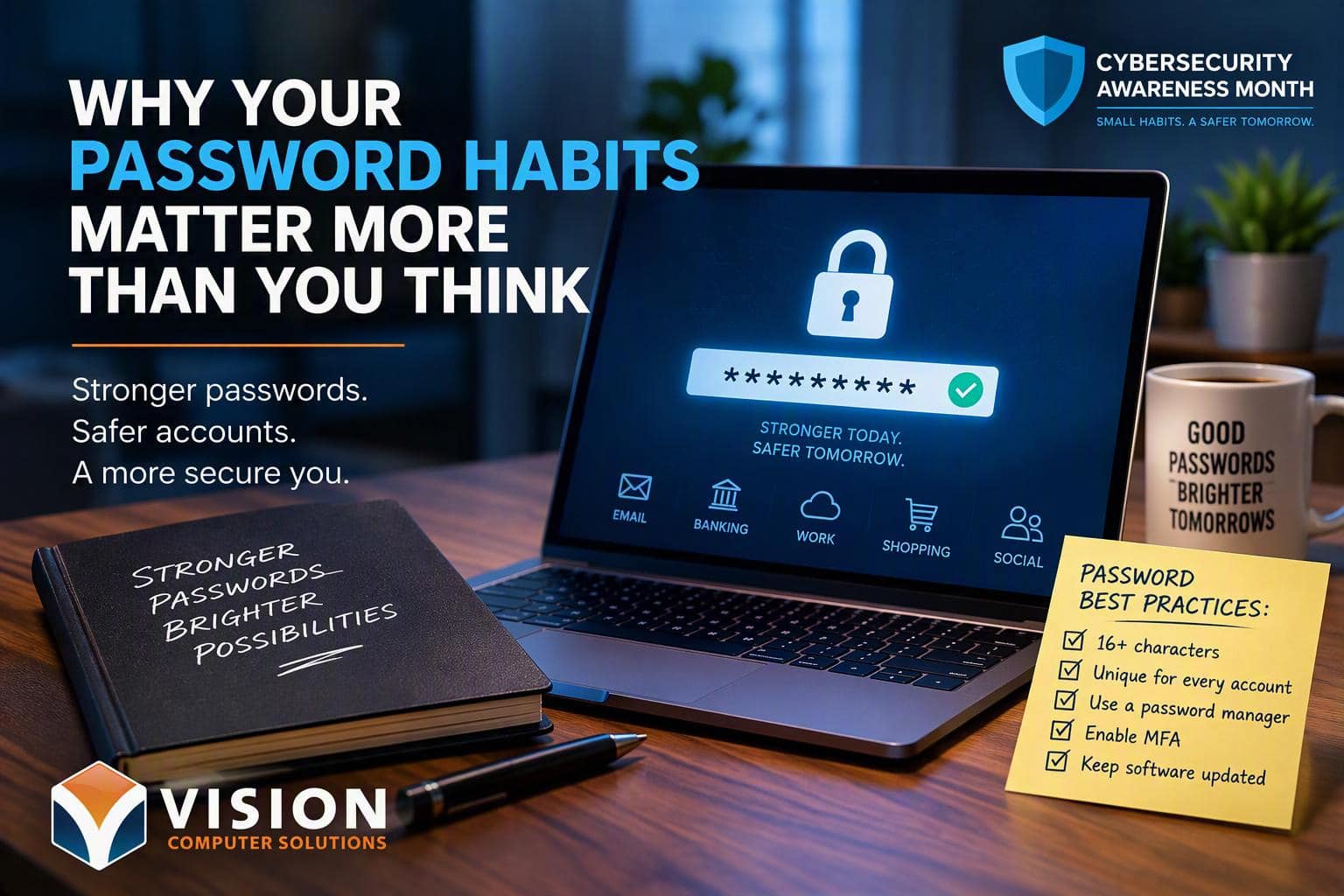
Cybersecurity Awareness Month is the perfect reminder that strong cybersecurity doesn’t start with expensive software or advanced technology. It starts with everyday habits. One of the most important habits is creating and using strong passwords. Developing good Password Habits is essential for protecting your digital life.
Most people understand that passwords are important, but many still underestimate how much damage a weak password can cause. Cybercriminals know that breaking through sophisticated security systems can be difficult, so they often take the easier route by targeting people and their login credentials instead. Improving your Password Habits can make a real difference.
Your Password Is the Front Door to Your Digital Life
Think about how many accounts you use every day. Email, banking, social media, shopping sites, work applications, and streaming services all rely on a password to help protect access. Consistent Password Habits can help secure each of these accounts effectively.
If an attacker gains access to just one account, they may be able to reach several others. For example, if someone compromises your email account, they can often use password reset links to gain access to additional services tied to that address.
In many cases, attackers don’t “hack” their way in. They simply log in using stolen credentials.
That makes your password one of the most important security tools you have.
Why Weak Passwords Create Serious Risks
Common passwords, short passwords, personal information, and reused credentials remain some of the biggest security risks facing both individuals and organizations.
Cybercriminals use automated tools capable of testing millions of password combinations in a short amount of time. Credentials based on names, birthdays, favorite sports teams, pets, or common words are often cracked quickly.
Even more concerning is password reuse.
Imagine using the same password for your email, online shopping, and banking accounts. If one website experiences a data breach, attackers can use those stolen credentials across multiple services. This technique, known as credential stuffing, remains one of the most common attacks used today.
One compromised password can quickly become several compromised accounts.
What Makes a Strong Password?
Creating a strong password is easier than many people think.
Strong passwords generally share several important characteristics:
- At least 16 characters long
- Unique for every account
- A mix of uppercase letters, lowercase letters, numbers, and symbols
- Not based on personal information
- Difficult to predict or guess
Longer passwords are significantly more difficult for automated tools to crack than shorter ones.
Another effective option is using passphrases made up of several random, unrelated words. These are often easier to remember while still providing excellent protection. In fact, updating your Password Habits to use passphrases is a smart move.
The goal isn’t to create something clever.
The goal is to create a password that is difficult for an attacker to predict.
Stop Trying to Remember Everything
One reason people reuse passwords is simple: they have too many accounts to manage.
The average person maintains dozens, if not hundreds, of online accounts. Remembering a unique password for each one can quickly become overwhelming.
That’s where password managers come in.
Password managers generate strong, random passwords and securely store them for you. Instead of trying to memorize every password, you only need to remember one strong master password.
These tools help eliminate many of the shortcuts that lead to weak account security and make it far easier to maintain unique credentials across all your accounts.
Strong Passwords and MFA Work Better Together
A strong password is essential, but it becomes even more effective when paired with Multi-Factor Authentication (MFA).
MFA adds a second layer of security by requiring an additional verification step, such as:
- A code sent to your phone
- An authentication app approval
- A biometric scan
Even if a cybercriminal obtains your password, MFA can help prevent unauthorized access to your account.
Think of it this way:
A password locks the front door.
MFA adds a deadbolt.
When used together, they dramatically reduce the likelihood of unauthorized access.
Good Security Habits Don’t Have to Be Complicated
Cybersecurity doesn’t require technical expertise. Most meaningful security improvements come from simple, repeatable habits.
- Use a unique password for every account
- Make passwords at least 16 characters long
- Use a password manager
- Enable MFA wherever possible
- Keep software and devices updated
- Be cautious of unexpected emails, texts, and login requests
Small actions performed consistently can have a significant impact on your overall security posture.
Final Thoughts
Cybersecurity threats continue to evolve, but one fact remains unchanged: passwords are still a critical line of defense.
Strong passwords make life significantly harder for cybercriminals. When paired with MFA and good security practices, they help protect personal information, financial accounts, and business data from unnecessary risk.
This Cybersecurity Awareness Month, take a few minutes to review your Password Habits. Updating a weak password, enabling MFA, or adopting a password manager may be some of the simplest and most effective steps you can take to improve your security.

Rebekah Klimkowski is passionate about helping businesses leverage technology as a strategic advantage. With experience working alongside organizations across a variety of industries, she focuses on cybersecurity, managed services, and digital transformation initiatives. Rebekah regularly writes about emerging technology trends, risk management, and practical ways businesses can improve their security and operational resilience.