
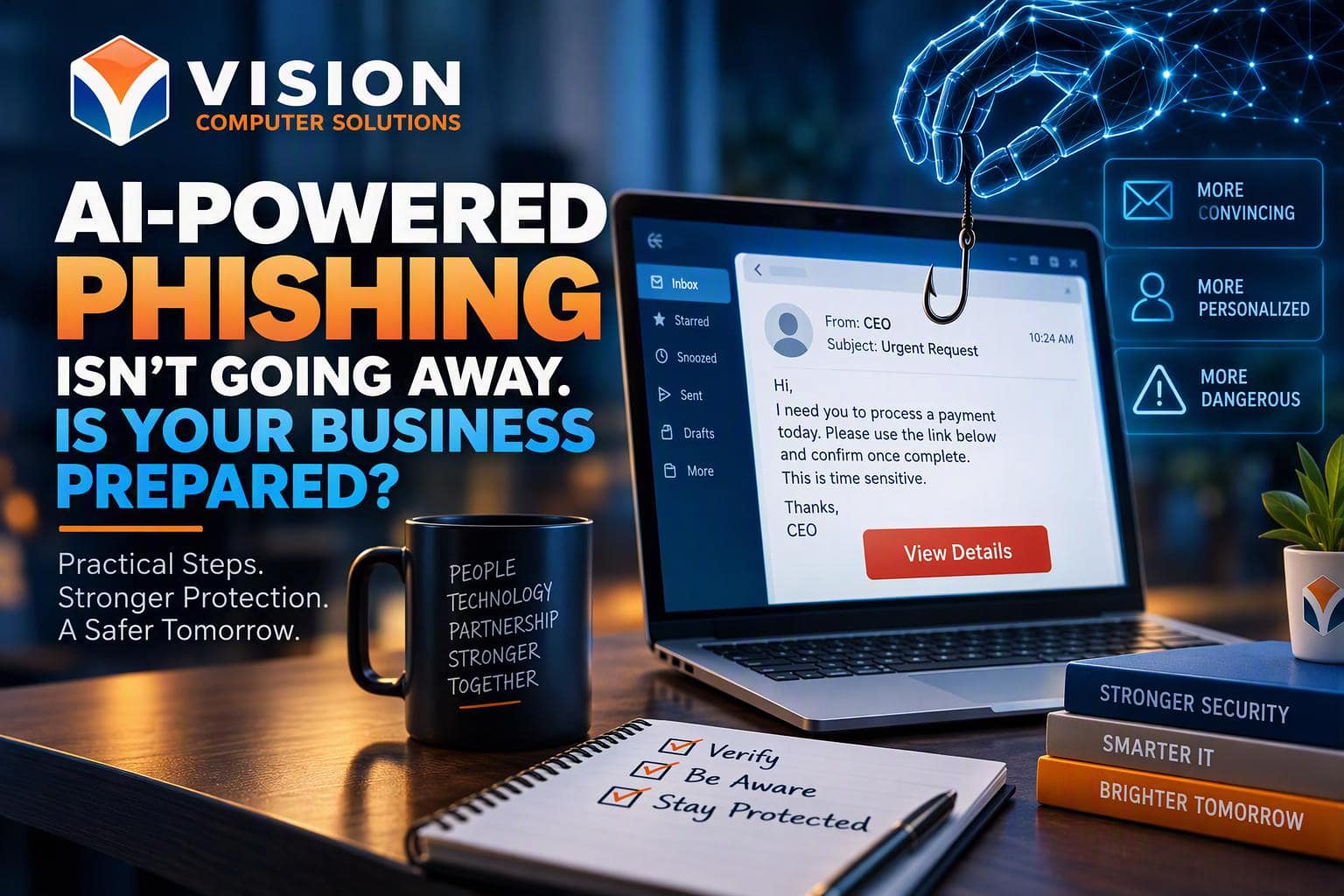
AI has changed a lot about how businesses operate. Unfortunately, it has also changed how cybercriminals operate, especially with the rise of AI-Powered Phishing tactics.
In our previous blog, AI-Powered Phishing: The New Threat Landscape, we explored how artificial intelligence can help cybercriminals create phishing messages that are polished, personalized, and much more convincing than the poorly written scams many people learned to recognize.
That creates a new challenge for businesses.
Employees can no longer rely on spelling mistakes, strange wording, or an obviously suspicious email to tell them something is wrong. AI-generated phishing attempts can look remarkably similar to normal business communication.
So, what should your organization do about it?
The answer isn’t to turn every employee into a cybersecurity expert. It’s to create layers of protection that combine technology, employee awareness, strong security practices, and an experienced IT partner.
Why AI Makes Phishing More Convincing
Traditional phishing attacks were often relatively generic. An attacker might send essentially the same message to thousands of people and wait for someone to click.
AI makes that process much more sophisticated.
As we discussed in our previous article, attackers can use publicly available information from places like LinkedIn, company websites, press releases, and social media to create messages tailored to an individual or organization.
A phishing email might reference:
- Your name or job title
- A coworker or executive
- A vendor your company works with
- A current event or company announcement
- A seemingly legitimate business request
AI also allows attackers to create variations of messages quickly and at scale, making phishing more difficult to identify based solely on familiar patterns.
And phishing isn’t limited to email.
Attackers can combine convincing emails with phone calls, messaging platforms, voice cloning, or deepfake video to reinforce the same false story.
That means the question businesses should be asking is no longer:
“Does this email look fake?”
Instead, employees need to ask:
“Can I verify that this request is legitimate?”
The Human Element Still Matters
Cybersecurity technology is an important part of protecting your organization, but employees still make decisions every day that can affect your security.
That’s exactly what phishing attacks are designed to exploit.
An attacker doesn’t necessarily need to defeat every cybersecurity tool protecting your network. Sometimes they simply need to convince one person to click a link, provide credentials, approve a request, or send sensitive information.
And AI can make those requests much more believable.
That’s why one of the most valuable habits employees can build is simply slowing down before responding to an unexpected request.
Before clicking, ask:
- Was I expecting this message?
- Is the sender creating unnecessary urgency?
- Is the request unusual?
- Can I verify it another way?
If an executive suddenly asks you to make a payment, for example, don’t rely solely on the email. Verify the request through a trusted communication method.
A 30-second verification can prevent a much larger problem.
Cybersecurity Requires More Than Employee Awareness
Training employees is important, but awareness shouldn’t be your organization’s only defense.
People make mistakes.
That’s why businesses need multiple layers of protection designed to reduce both the likelihood and potential impact of a successful phishing attack.
Depending on your organization’s environment and risk profile, that broader security strategy may include areas such as:
- Email security
- Multi-factor authentication (MFA)
- Identity and access controls
- Endpoint protection
- Security monitoring
- Data protection
- Backup and recovery planning
- Employee cybersecurity awareness
- Incident response planning
The goal isn’t to depend on one perfect solution.
It’s to make sure one mistake doesn’t automatically become a major security incident.
How Vision Computer Solutions Can Help
Keeping up with cybersecurity threats while running a business can be difficult, especially as those threats continue to change.
Vision Computer Solutions can help businesses take a proactive approach to IT and cybersecurity.
Rather than treating cybersecurity as a collection of individual products, we can help you look at the bigger picture: your people, technology, security practices, and overall IT environment.
Strengthening Your Cybersecurity Foundation
The first step is understanding where your organization stands today.
Vision Computer Solutions can work with your business to identify cybersecurity concerns and determine where stronger protections may be needed.
That means looking beyond “Do we have antivirus?” and considering how your organization’s systems, users, data, and processes work together.
Protecting Your Users and Accounts
AI-powered phishing frequently relies on convincing someone to provide information or approve something they shouldn’t.
Strong identity and access protections can add another barrier between an attacker and your organization’s systems.
Controls such as MFA can help reduce the risk associated with stolen credentials, while good access practices can help ensure users have appropriate access to the resources they need.
Building a More Security-Aware Team
Technology can’t make every decision for your employees.
Your team still needs to recognize suspicious situations and know what to do when something doesn’t feel right.
Cybersecurity awareness helps employees build better habits around email, passwords, authentication requests, links, attachments, and unexpected requests.
The goal isn’t fear.
It’s confidence.
Employees should feel comfortable stopping, verifying, and reporting suspicious activity instead of feeling pressured to make an immediate decision.
Monitoring and Managing Your IT Environment
Cybersecurity isn’t something you configure once and forget.
Businesses change. Employees come and go. Software changes. New vulnerabilities emerge, and attackers continue adjusting their tactics.
Having an IT partner helps keep cybersecurity part of an ongoing technology strategy rather than something that only gets attention after an incident.
You Don’t Have to Fight AI With Guesswork
AI-powered phishing makes it easier for cybercriminals to create messages that look legitimate.
But that doesn’t mean your employees need to become suspicious of every email they receive.
The better approach is to build good habits and put the right safeguards behind them.
Slow down. Verify unusual requests. Use strong security controls. Train your employees. And make sure you have an IT partner who understands how today’s threats affect your business.
Cybercriminals may be getting better tools.
Your business should, too.
Is Your Business Ready for the Next Phishing Attempt?
If you’re unsure whether your current cybersecurity strategy is prepared for today’s threats, Vision Computer Solutions can help you take a closer look at your IT environment and identify opportunities to strengthen your defenses.
Don’t wait for a convincing phishing email to reveal the gaps in your cybersecurity strategy.
Contact Vision Computer Solutions today to start a conversation about protecting your people, your data, and your business.

Zak McGraw, Digital Marketing Manager at Vision Computer Solutions in the Detroit Metro Area, shares tips on MSP services, cybersecurity, and business tech.