
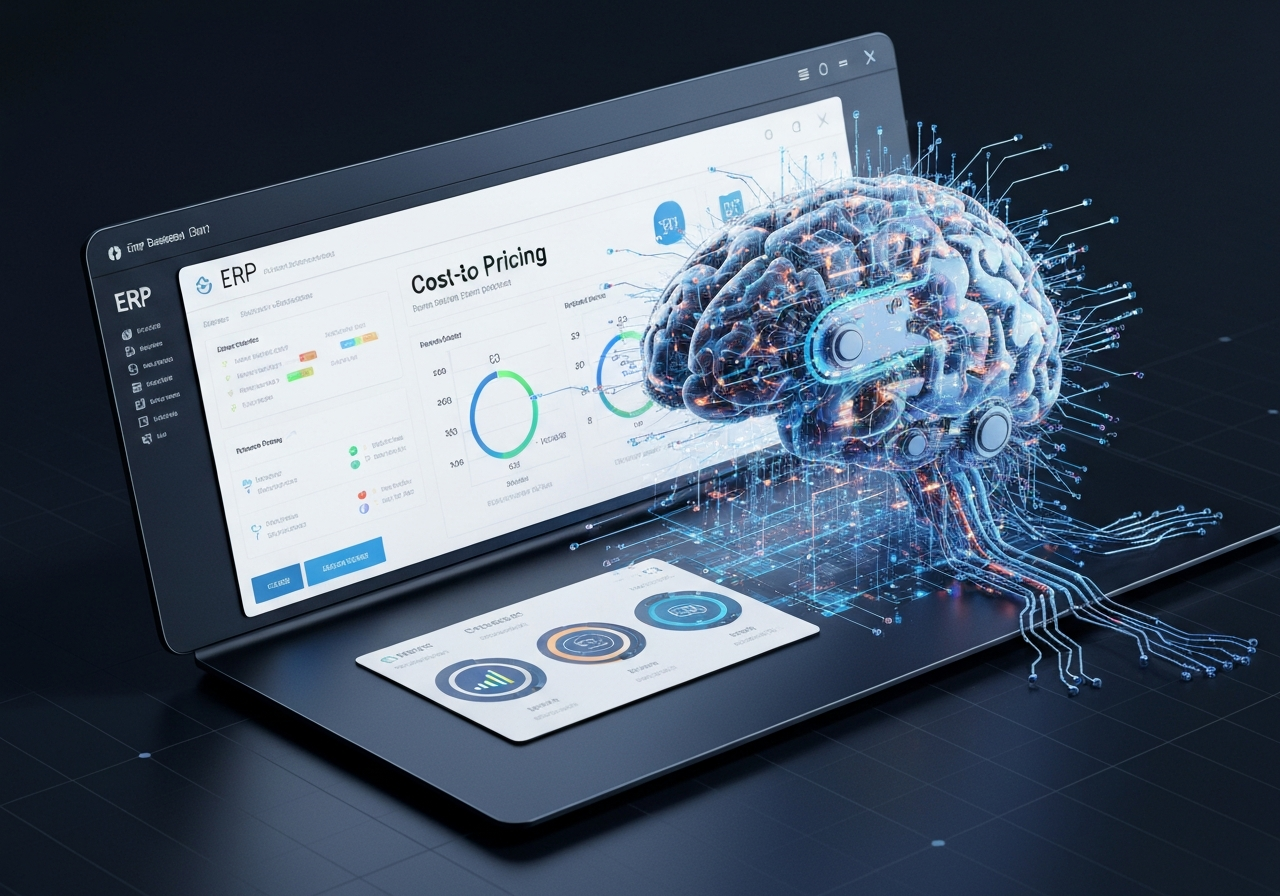
In today’s fast-paced market, staying competitive means being smarter and more efficient. What if you could perfectly align your costs with your prices automatically? The combination of an enterprise resource planning (ERP) system and artificial intelligence (AI) is making this a reality. This powerful duo is revolutionizing business operations by transforming how companies manage data, make decisions, and drive profitability. Let’s explore how integrating AI into your ERP can unlock new levels of efficiency and strategic advantage.
Understanding ERP Systems in Modern Business
At its core, enterprise resource planning (ERP) is software that organizations use to manage their daily business activities. It acts as a central hub, tying together everything from finance and human resources to manufacturing and the supply chain. An ERP system ensures that information flows seamlessly between different business functions.
This integration eliminates data silos and creates a single source of truth for your entire organization. By connecting all your business processes, you gain a clear, continuously updated view of your operations. We will examine the key components of an ERP system and why it has become indispensable for modern companies.
What is an ERP System?
An ERP system is a category of business management software that integrates your main business processes, often in real time. Think of it as the central nervous system for your company. It uses a central database to collect, store, manage, and interpret data from various departments, including accounting, manufacturing, and sales.
This shared database ensures that everyone in the organization works with the same information. For example, when a sales order is entered, the system can automatically update inventory levels, schedule production, and create an invoice without manual intervention. This level of integration is what sets ERP software apart from standalone applications.
Ultimately, the goal of enterprise resource planning is to facilitate a smooth flow of information between all business functions and even manage connections with outside stakeholders. By providing an integrated view of core processes, an ERP system helps you track business resources like cash, raw materials, and production capacity with complete accuracy.
Why Do Companies Use ERP?
Companies use ERP solutions to enhance operational efficiency and gain a competitive edge. One of the biggest benefits is the creation of a single source of truth. Instead of disconnected spreadsheets and separate databases, an ERP system centralizes your business data. This eliminates duplication, reduces errors, and ensures data integrity across the board.
This unified approach allows management to make decisions faster and with more confidence. With real-time information readily available, you can improve business insight and streamline processes based on best practices. An ERP solution creates a more agile and flexible company that can adapt quickly to market changes.
Furthermore, this business management software improves collaboration. When all users share data in contracts, requisitions, and purchase orders, workflows become more efficient. The consistent infrastructure from the back office to the front office results in a common user experience, which increases adoption rates and reduces risk through better financial controls.
Main Components of ERP Platforms
An ERP platform is made up of different modules, each designed to handle specific business functions. These modules are interconnected, sharing data from a central database to ensure every department is on the same page. This modular design allows you to implement the functionalities that best fit your business needs.
The applications that make up the system share data across various departments, which provides a cohesive operational view. This integration is what makes an ERP so powerful, as it connects disparate parts of the business into a unified whole.
Here are some of the most common functional areas, or modules, found in an ERP system:
- Financial Management: Manages the general ledger, accounts payable/receivable, and financial consolidation.
- Human Resources: Handles recruiting, payroll, training, and benefits administration.
- Supply Chain Management: Includes purchasing, inventory management, warehousing, and order processing.
- Customer Relationship Management (CRM): Manages sales, marketing, customer service, and contact information.
- Manufacturing: Controls engineering, work orders, scheduling, and quality control.
Common Industries Leveraging ERP Solutions
While ERP systems were initially focused on the manufacturing sector, their use has expanded dramatically. Today, businesses of all sizes and across various industries rely on ERP solutions to streamline their business operations. From large enterprises to growing small businesses, the benefits of integrated data and processes are universal.
Within an organization, users from nearly every department interact with the ERP system. Finance teams use it for financial reporting, while the supply chain division manages procurement and inventory. Even non-profit organizations and government bodies have adopted ERP systems to improve productivity and performance.
Here are some common industries that leverage ERP solutions:
- Manufacturing: A manufacturing company uses ERP for production planning, inventory control, and managing bills of materials.
- Retail: Retailers manage supply chains, inventory, and sales data through an integrated platform.
- Healthcare: Hospitals and clinics use ERP for patient data management, billing, and regulatory compliance.
- Public Sector: Government agencies implement ERP for resource planning, budgeting, and office automation.
Exploring Cost-to-Pricing Alignment
Cost-to-pricing alignment is the strategic process of ensuring your pricing decisions accurately reflect the total cost of producing and delivering a product or service. Without this alignment, you risk setting prices too low, which hurts profit margins, or too high, which can drive customers away. It requires a deep and accurate cost analysis.
Achieving this alignment means having a clear view of all contributing costs, from raw materials and labor to logistics and overhead. Business intelligence tools within an ERP system are essential for gathering and analyzing this data to inform your pricing decisions effectively. Let’s look closer at what this alignment entails and why it’s so important.
What Is Cost-to-Pricing Alignment?
Cost-to-pricing alignment is about creating a direct and dynamic link between your expenses and your sales prices. It goes beyond simply adding a markup to your costs. Instead, it involves integrating data from various business functions to understand the true cost of goods sold and set prices that support your strategic goals.
This process relies on data from core business processes managed within an ERP system. For instance, information from your material requirements and production planning modules gives you precise data on manufacturing costs. By connecting this data to your sales and order management modules, you can ensure that your pricing reflects every expense incurred.
The goal is to move from static pricing models to a more responsive approach. When your costs fluctuate due to supply chain disruptions or market changes, your pricing should be able to adapt accordingly. True cost-to-pricing alignment makes this possible by unifying data across the entire organization.
The Importance of Accurate Cost Analysis
Accurate cost analysis is the foundation of smart business strategy and a critical component of cost-to-pricing alignment. If you don’t have a precise understanding of your costs, you cannot make informed pricing decisions, manage your budget effectively, or identify areas for improvement. Inaccurate analysis can lead to shrinking profit margins and poor resource allocation.
An integrated ERP system is vital for achieving this accuracy. By centralizing data management, it eliminates the inconsistencies and errors common with disconnected systems. This provides a single, reliable source of information for your financial management and business intelligence tools to work with.
Here’s why accurate cost analysis is so important:
- Informed Pricing: It allows you to set prices that cover all costs and achieve target profit margins.
- Improved Profitability: By identifying and controlling high-cost areas, you can directly boost your bottom line.
- Better Risk Management: Understanding your cost structure helps you anticipate the financial impact of market volatility.
- Strategic Planning: It provides the data needed for effective budgeting, forecasting, and long-term business planning.
Link Between Cost Data and Strategic Pricing
The link between cost data and strategic pricing is direct and powerful. Your pricing decisions should never be made in a vacuum; they must be grounded in a comprehensive understanding of your costs. When your cost data is accurate, up-to-date, and easily accessible, you can develop pricing strategies that are both competitive and profitable.
An ERP system strengthens this link by integrating various business processes. It connects the data from procurement, manufacturing, and supply chain modules with your sales and order management functions. This provides a holistic view, enabling you to see how changes in one area, like raw material costs, should impact your pricing decisions.
This integration allows you to be proactive rather than reactive. As market changes occur, you can quickly analyze the impact on your costs and adjust your pricing strategy accordingly. This agility ensures you can protect your margins and maintain a strong market position, turning your cost data into a strategic asset.
Traditional Challenges in Aligning Costs with Pricing
Traditionally, businesses have faced significant hurdles in aligning costs with pricing. Many of these challenges stem from outdated technology and fragmented processes. Legacy systems often operate in silos, creating “islands of information” where data is inconsistent and difficult to access, making a unified view of operational costs nearly impossible.
This disconnection forces reliance on manual data entry and disconnected spreadsheets, which are prone to errors and time-consuming to manage. When data is not normalized across departments, a simple component like a brake pad might have different names in different systems, making it hard to track total spending and negotiate better prices.
These traditional challenges prevent businesses from adapting to their true business needs. Here are some common obstacles:
- Data Silos: Information is trapped in separate departmental systems.
- Manual Data Entry: Increases the risk of errors and wastes valuable time.
- Lack of Real-Time Insight: Decisions are based on outdated information.
- Inconsistent Data: Different parts of the business use different definitions and formats.
- Difficulty Adapting: Legacy systems are rigid and cannot easily respond to changing business requirements.
AI in ERP: Unlocking Automation and Efficiency
The integration of artificial intelligence (AI) is transforming ERP systems from passive data repositories into active, intelligent platforms. AI and machine learning bring a new level of automation and efficiency, allowing your ERP system to not only manage processes but also learn from them and make predictive suggestions. This is particularly powerful for complex tasks like cost-to-pricing alignment.
By leveraging AI, your ERP can analyze vast amounts of data, identify patterns, and automate decision-making workflows. This enhanced data integration helps you unlock deeper insights and streamline operations across the entire enterprise. Let’s look at how AI is reshaping the ERP landscape.
The Rise of AI-Driven ERP Solutions
The evolution of ERP software has paved the way for the rise of AI-driven solutions. The shift from on-premises systems to cloud ERP has been a game-changer. Cloud platforms provide the flexible, scalable infrastructure needed to support advanced AI technologies and handle the massive data sets required for machine learning algorithms.
Modern cloud ERP applications are increasingly embedded with AI and machine learning capabilities. Instead of requiring expensive, periodic upgrades, these systems are updated regularly by the provider, ensuring you always have access to the latest innovations. This model makes advanced technologies more accessible to businesses of all sizes.
This new generation of ERP software uses AI to enhance everything from data management to user experience. Digital assistants can simplify tasks, while machine learning can provide predictive insights that were previously unattainable. The result is an ERP system that is smarter, more intuitive, and far more powerful.
How AI to Automate Cost-to-Pricing Alignment
Artificial intelligence fundamentally changes how businesses achieve cost-to-pricing alignment by introducing intelligent automation. Instead of relying on manual analysis and periodic reviews, AI algorithms can continuously monitor cost data from procurement, manufacturing, and logistics in real time. This automated oversight improves business efficiency by freeing up your team for more strategic work.
When a cost changes—for instance, a supplier increases the price of a raw material—the AI can instantly calculate the impact on the total cost of the affected products. It can then recommend or even automatically apply an adjusted price based on predefined rules and margin targets. This ensures your pricing is always aligned with your current cost structure.
AI improves efficiency in several key ways:
- Automated Data Monitoring: AI constantly tracks cost fluctuations across the enterprise resource landscape.
- Real-Time Analysis: It processes data instantly to calculate the impact on profit margins.
- Intelligent Recommendations: The system suggests optimal pricing adjustments during order processing.
- Streamlined Workflows: Automation reduces the need for manual intervention in routine pricing updates.
Key AI Technologies Enhancing ERP Systems
Several key AI technologies are being embedded into modern ERP systems to deliver new capabilities and deeper insights. These technologies work together, leveraging the data integration of the ERP platform to create a smarter, more responsive system. They go beyond traditional business intelligence to offer forward-looking, actionable guidance.
Machine learning, for example, allows the system to learn from historical data to identify trends and make predictions. The Internet of Things (IoT) provides real-time data from sensors on factory floors or in supply chains, which AI can then analyze to optimize operations. These technologies transform the ERP from a system of record into a system of intelligence.
Here are some of the key technologies enhancing ERP systems:
- Machine Learning: Enables predictive analytics for forecasting demand, costs, and market trends.
- Artificial Intelligence (AI): Automates complex processes and provides intelligent recommendations.
- Digital Assistants: Offer conversational interfaces to simplify user interactions with the ERP.
- Internet of Things (IoT): Delivers real-time data from physical assets for enhanced monitoring and control.
- Blockchain: Provides a secure and transparent ledger for tracking transactions in the supply chain.
Data Integration and Machine Learning Applications
The synergy between data integration and machine learning is what makes an AI-driven ERP so powerful. An ERP system’s primary strength is its ability to create a unified data set from across all business processes. This clean, normalized, and centralized data is the perfect fuel for machine learning algorithms.
Machine learning models can analyze this integrated data to uncover patterns that would be invisible to human analysts. For example, in supply chain management, machine learning can analyze historical procurement data, supplier performance, and market trends to predict future material costs with a high degree of accuracy. This is a key differentiator from other business management software that lacks this deep integration.
These predictive insights allow for more proactive decision-making. Instead of just reacting to supply chain disruptions, you can anticipate them and adjust your strategies accordingly. This combination of comprehensive data integration and intelligent analysis helps optimize business processes, reduce costs, and drive growth.
Key Benefits of AI-Driven Cost-to-Pricing Alignment
Adopting an AI-driven approach to cost-to-pricing alignment delivers a host of significant benefits. By leveraging artificial intelligence, you move beyond basic business intelligence to achieve true price optimization. This leads to substantial cost savings, enhanced accuracy, and a stronger competitive position in the market.
The primary advantage is the ability to make smarter, data-driven decisions in real time. This boosts profitability while simultaneously reducing the manual effort required to manage pricing. Let’s explore some of the key benefits you can expect from this powerful combination of technologies.
Real-Time Data Processing for Pricing Optimization
One of the most transformative benefits of an AI-enhanced ERP is its ability to process real-time data for pricing optimization. Traditional business intelligence tools often rely on historical data, which means your pricing decisions might be based on outdated information. AI, however, can analyze live data streams from across your operations.
This means that as costs fluctuate in your supply chain or as new orders come through your order management system, the AI can instantly recalculate optimal price points. This dynamic capability ensures that your pricing is always aligned with current market conditions and internal costs, protecting your margins on every single transaction.
Effective data management within the ERP ensures that the AI has access to accurate and complete information. By turning this real-time data into actionable pricing strategies, you move from a reactive stance to a proactive one, gaining a significant advantage over competitors who are still relying on static pricing models.
Enhanced Accuracy in Cost and Pricing Decisions
Accuracy is paramount when it comes to cost analysis and pricing decisions. Even small errors can compound over time, leading to significant financial losses. AI enhances accuracy by eliminating the manual calculations and guesswork that often plague traditional processes. It analyzes comprehensive data sets with a level of precision that is impossible to achieve manually.
By integrating data from all business operations, from procurement to production, the AI gets a complete picture of your true costs. This allows it to perform a more thorough cost analysis, ensuring that no expense is overlooked. When this accurate cost data is used to inform your pricing decisions, you can be confident that your prices are both profitable and competitive.
The result is more reliable financial reports and a clearer understanding of your company’s financial health. This enhanced accuracy builds trust in your data and empowers your team to make strategic decisions with confidence, knowing they are based on a solid, data-driven foundation.
Increased Profit Margins and Reduced Manual Work
A direct outcome of AI-driven cost-to-pricing alignment is a significant boost to your profit margins. By ensuring that your prices always reflect your total cost, you prevent margin erosion caused by rising expenses. AI-powered price optimization allows you to capture the maximum value from every sale, directly contributing to business growth.
At the same time, automation drastically reduces the need for manual data entry and analysis. Your finance and sales teams can stop spending countless hours in spreadsheets and instead focus on high-value strategic initiatives. This improvement in operational efficiency not only lowers costs but also increases employee satisfaction and productivity.
Here’s how this approach drives profitability and efficiency:
- Dynamic Pricing: Automatically adjusts prices to protect margins as costs change.
- Process Automation: Eliminates tedious manual tasks related to cost and price management.
- Strategic Focus: Frees up employees to work on activities that drive business growth.
- Cost Control: Provides deeper insights into your total cost structure, revealing opportunities for savings.
Continuous Improvement Through Predictive Analytics
Beyond real-time adjustments, AI enables continuous improvement through predictive analytics. Using machine learning algorithms, your ERP system can analyze historical data to forecast future trends in costs, demand, and market behavior. This forward-looking capability transforms your approach to cost analysis from reactive to proactive.
Instead of just responding to cost increases, you can anticipate them. Predictive analytics can identify patterns that suggest a future rise in raw material prices or shipping costs, allowing you to adjust your business processes or procurement strategies in advance. This foresight gives you a powerful strategic advantage.
This moves you beyond traditional business intelligence, which typically focuses on what has already happened. By leveraging machine learning to predict what will happen, you can continuously refine your pricing strategies, optimize your supply chain, and make smarter, more informed decisions that drive long-term success.
Types of ERP Software Featuring Cost-to-Pricing Automation
When considering an ERP software solution with cost-to-pricing automation, you’ll encounter several deployment models and types. The main options include cloud ERP, on-premises ERP, and hybrid approaches that combine both. Each has its own set of advantages depending on your company’s size, budget, and specific needs.
In addition to deployment models, many vendors offer industry-specific ERP solutions tailored to the unique challenges of sectors like manufacturing or retail. Understanding these different types will help you choose the right platform to support your automation goals. Let’s compare the most common options available today.
Cloud-Based vs. On-Premises ERP Solutions
The choice between a cloud ERP and an on-premises ERP is one of the most fundamental decisions in any ERP implementation. On-premises ERP software is installed locally on your company’s own hardware and servers. This model gives you direct control over your data and infrastructure but requires a significant upfront investment in hardware and IT staff.
In contrast, a cloud ERP is hosted on the provider’s remote servers and accessed over the internet. This software-as-a-service (SaaS) model eliminates the need for capital expenditure on hardware and transfers the responsibility for management, updates, and security to the vendor. This makes advanced ERP capabilities, including AI, more accessible for small businesses.
Here is a comparison of the two models:
| Feature | On-Premises ERP | Cloud ERP |
|---|---|---|
| Cost Model | High upfront capital expense (CapEx) for licenses and hardware. | Subscription-based operational expense (OpEx). |
| Implementation | Longer implementation times, often with extensive customization. | Faster implementation with less need for customization. |
| Maintenance | Managed internally by your IT team. | Managed by the vendor, including patches and updates. |
| Accessibility | Limited to the company’s network unless configured otherwise. | Accessible from any location with an internet connection. |
| Scalability | Scaling requires purchasing and configuring new hardware. | Easily scalable by adjusting the subscription plan. |
Leading ERP Platforms with Advanced AI Capabilities
As the demand for intelligent automation grows, leading ERP vendors are heavily investing in advanced AI capabilities. These platforms are no longer just systems for recording transactions; they are becoming strategic business management software designed to drive efficiency and insight. When evaluating options, it’s important to look for an ERP vendor that has a clear roadmap for AI innovation.
These advanced systems embed AI and machine learning directly into their core modules, enhancing everything from financial analysis to supply chain optimization. The goal is to deliver a seamless user experience where intelligent features feel like a natural extension of the system, improving overall system performance without adding complexity.
Here are some popular examples of ERP platforms known for their AI capabilities:
- Oracle Fusion Cloud ERP
- Microsoft Dynamics 365
- SAP S/4HANA Cloud
- Workday
- Infor CloudSuite
These vendors offer both broad, cross-industry solutions and industry-specific ERP versions to meet diverse business needs.
Industry-Specific ERP Software Examples
While many ERP systems are designed to be general-purpose, some are tailored to meet the unique demands of specific industries. This industry-specific ERP software comes pre-configured with features and workflows relevant to a particular sector, which can speed up implementation and provide more immediate value.
For a manufacturing company, an industry-specific ERP might include advanced modules for production scheduling, bill of materials management, and shop floor control. For a retail business, the focus might be on sophisticated inventory management, point-of-sale integration, and e-commerce capabilities. These tailored solutions help improve customer satisfaction by streamlining industry-critical processes.
Here are some examples of functionalities in industry-specific ERPs:
- Manufacturing: Includes material requirements planning and quality control workflows.
- Retail: Features advanced supply chain management and multi-channel sales integration.
- Professional Services: Offers robust project management and time and expense tracking.
- Healthcare: Provides tools for regulatory compliance and patient financial reporting.
Scalability and Customization Options
When selecting an ERP system, scalability and customization are two critical factors to consider. Your chosen solution must be able to grow with your business and adapt to your unique business needs. Scalability ensures the system can handle an increasing volume of transactions and users without a decline in performance.
Customization allows you to modify the software to match your specific requirements. However, heavy customization can be a double-edged sword. While it can improve user acceptance, it may also increase implementation time and costs, and potentially complicate future upgrades. Modern ERP applications often favor configuration—using built-in settings to modify the system—over deep code customization.
Consider these factors when evaluating ERP options:
- Scalability: Can the system support your projected business growth? Cloud ERPs typically offer superior scalability.
- Configuration vs. Customization: Does the vendor provide extensive configuration options to meet your needs without extensive code changes?
- Third-Party Extensions: Can the system be extended with third-party ERP applications to add specialized functionality?
- Upgrade Path: Will your customizations be preserved during system upgrades, or will they need to be re-implemented?
Implementation Strategies for AI-Enhanced Cost-to-Pricing
Successfully implementing an AI-enhanced ERP for cost-to-pricing alignment requires a thoughtful and strategic approach. It’s more than just a technology project; it’s a business transformation initiative. A successful ERP implementation involves careful planning, from assessing your organization’s readiness to managing data migration and employee training.
Proper AI adoption depends on having a solid foundation in place. This includes clean data, clear objectives, and a team that is prepared for the changes ahead. Let’s walk through the key strategies for a successful implementation that delivers real value.
Assessing Organizational Readiness
Before you begin an ERP implementation, it’s crucial to assess your organizational readiness. A poor understanding of your current processes and business needs is a leading cause of project failure. This assessment involves looking at your technology, processes, and people to identify any potential roadblocks.
You need to analyze your existing business processes, from the supply chain and order fulfillment to financial reporting. This analysis will help you identify opportunities for improvement and ensure that the new system aligns with your strategic goals. It’s also a chance to evaluate your data management practices and determine if your data is clean and ready for migration.
Here are key areas to assess for organizational readiness:
- Process Analysis: Do you have a clear understanding of your current workflows and where they can be improved?
- Strategic Alignment: Does the project align with your overall business objectives?
- Data Quality: Is your existing data accurate, consistent, and ready for migration?
- Executive Sponsorship: Is there strong support from leadership to champion the project and drive change?
Selecting the Right ERP Solution for Your Needs
Choosing the right ERP solution is a critical decision that will impact your business for years to come. The goal is to find an ERP vendor whose platform aligns with your specific requirements, budget, and long-term vision. This involves a formal selection process where you evaluate different options against a clear set of criteria.
Start by documenting your specific requirements for each business area, including finance, operations, and sales. Consider your needs for business intelligence, risk management, and any industry-specific functionalities. Use this documentation to compare what different vendors offer and how well their solutions fit your needs out of the box.
When selecting an ERP solution, consider the following:
- Functional Fit: Does the ERP solution meet your documented business requirements?
- Technology and Architecture: Is the platform modern, scalable, and aligned with your IT strategy (e.g., cloud vs. on-premises)?
- Vendor Reputation: Does the ERP vendor have a strong track record of success and good customer support?
- Total Cost of Ownership: Look beyond the initial license fee to consider implementation, training, and maintenance costs.
- AI and Innovation Roadmap: Does the vendor have a clear vision for integrating future technologies?
Data Preparation and Migration Approaches
Data migration is the process of moving your existing data into the new ERP system’s central database. This is a critical and often underestimated part of an implementation. A successful data migration requires careful planning and a thorough understanding of your data. Incomplete or inaccurate data can undermine the entire project.
Your data management strategy should begin by identifying which data needs to be migrated. Not all historical data may be necessary or compatible with the new system. You’ll need to clean, de-duplicate, and restructure the data to fit the new format. It’s also a time to consider archiving policies for data that won’t be moved.
A structured approach is key to successful data migration:
- Identify Data: Determine exactly which data needs to be moved to the new system.
- Cleanse Data: Correct errors, remove duplicates, and standardize formats.
- Map Data: Define how data from the old system will map to the fields in the new central database.
- Test Migration: Perform several test runs to ensure the migration process is smooth and error-free before the final cutover.
- Validate Data: After migration, validate the data to ensure its integrity and accuracy.
Training Teams for AI Adoption in ERP
Successful AI adoption in your ERP system depends on effective training. Your teams need to understand not only how to use the new software but also how the new AI-driven processes will change their day-to-day work. Training should be tailored to different user groups across various business functions.
The goal is to build confidence and show employees how the new system will help them perform their jobs more effectively. For example, show the customer service team how AI-powered insights can help them better serve clients or demonstrate to the finance team how automation will reduce manual report generation.
Effective training strategies for AI adoption include:
- Role-Based Training: Provide training that is specific to each user’s job function.
- Hands-On Practice: Allow users to work in a test environment to get comfortable with the system.
- Highlight the “Why”: Explain the benefits of the new system to encourage buy-in.
- Ongoing Support: Offer continuous learning resources and support after the initial rollout.
- Champion Users: Identify power users who can help mentor their colleagues and promote business growth.
Overcoming Common Challenges in Adoption
Even with the best technology, ERP and AI adoption can face challenges. These hurdles often relate to people, processes, and data rather than the software itself. Common issues include poor data quality, difficulties with integration, resistance to change, and navigating complex compliance requirements.
Overcoming these challenges requires a proactive approach. By anticipating potential problems and developing strategies to address them, you can ensure a smoother transition and maximize the return on your investment. Let’s discuss how to tackle some of the most common adoption challenges.
Addressing Data Quality and Integration Issues
Poor data quality is one of the biggest threats to a successful ERP implementation. If you feed your new system inaccurate or inconsistent data, you’ll get unreliable results—a “garbage in, garbage out” scenario. This is especially true for AI, which depends on high-quality data to function effectively.
Issues often arise when migrating data from multiple legacy systems, each with its own formats and definitions. Integrating these disparate sources into a single central database requires a rigorous data cleansing and validation process. Without it, you could face problems in critical areas like order management and financial reporting.
To address these issues, you should:
- Conduct a Data Audit: Before migration, audit your existing data to identify quality issues.
- Establish Data Governance: Create clear standards and ownership for data quality moving forward.
- Invest in Data Cleansing Tools: Use software to help automate the process of de-duplicating and standardizing data.
- Validate After Migration: Thoroughly check the data in the new system to ensure the integration was successful.
Managing Change Within the Organization
A successful ERP implementation is as much about people as it is about technology. Change can be difficult, and resistance from employees is a common obstacle. Effective change management is essential for getting buy-in from different departments and ensuring that everyone is prepared for the new way of working.
The process begins with clear communication from leadership about the vision and benefits of the project. It’s important to involve employees from various business operations early in the process to get their feedback and make them feel like part of the solution. Comprehensive team training is also a critical component of managing this transition.
Here are key elements of a strong change management plan:
- Clear Communication: Regularly communicate the project’s goals, progress, and benefits.
- Employee Involvement: Involve end-users in the design and testing phases.
- Leadership Support: Ensure visible and consistent support from executives.
- Targeted Training: Provide role-specific training to build confidence and skills.
- Celebrate Successes: Acknowledge milestones and successes along the way to maintain momentum.
Balancing Security, Privacy, and Compliance
When you centralize your company’s data in an ERP system, protecting that information becomes a top priority. You must balance the need for accessibility with robust security, privacy, and compliance measures. This is especially true when handling sensitive data like financial records or customer information.
Your ERP system must have strong access controls to ensure that employees can only see the information relevant to their roles. Modern cloud ERP providers often have large, dedicated security teams and advanced tools to protect against threats. However, you are still responsible for configuring the system correctly and adhering to regulatory compliance standards.
To maintain this balance, you should:
- Implement Role-Based Access: Restrict access to sensitive data based on job function.
- Choose a Secure Vendor: Select an ERP provider with a proven track record in security.
- Stay Current with Regulations: Ensure your system and processes comply with standards like GDPR or Sarbanes-Oxley.
- Conduct Regular Audits: Periodically review security settings and access logs to identify potential risks.
- Train Employees on Security Best Practices: Educate your team on how to handle sensitive data responsibly.
Budgeting and ROI Considerations
Implementing an AI-enhanced ERP system is a significant investment, and careful budgeting is essential. The total cost includes not only software licenses but also implementation services, training, hardware (for on-premises), and potential customizations. Understanding the full financial picture is key to making a sound decision.
To justify this investment, you need to calculate the potential return on investment (ROI). The ROI comes from both tangible cost savings and intangible benefits. Cost savings can be measured in areas like reduced inventory, lower operational costs, and improved efficiency from automation. These savings directly impact your financial management.
When building your business case, consider these ROI drivers:
- Operational Efficiency: Quantify time saved through automation and streamlined processes.
- Cost Savings: Estimate reductions in inventory, procurement costs, and manual labor.
- Increased Profitability: Project the impact of optimized pricing and improved margins.
- Enhanced Decision-Making: While harder to quantify, better insights lead to smarter strategies and long-term business growth.
AI-Driven ERP in Day-to-Day Business Operations
How does an AI-driven ERP system actually change how your business runs day to day? The impact is felt across every department. From automating financial reporting to optimizing inventory management, AI infuses intelligence into your routine operations, making them faster, smarter, and more efficient.
This integration transforms your ERP from a passive database into an active partner that helps your team make better decisions. Let’s look at some concrete examples of how AI enhances daily tasks in finance, sales, procurement, and collaboration.
Automating Routine Financial Tasks
In the finance department, AI-powered automation can eliminate many of the most repetitive and time-consuming tasks. This allows your finance team to shift its focus from manual data entry to strategic analysis and advising the business. This is a significant impact on one of the core business functions.
For example, AI can automate the process of reconciling accounts, matching purchase orders to invoices, and generating standard financial reports. It can also analyze expense reports to flag anomalies or potential compliance issues, reducing risk and saving time. This automation streamlines workflows that connect to order processing and other departments.
Here are some routine financial tasks that AI can automate:
- Account Reconciliation: Automatically matching transactions across different accounts.
- Invoice Processing: Extracting data from invoices and matching them with purchase orders.
- Expense Report Auditing: Using AI to identify out-of-policy expenses.
- Generating Financial Reports: Automating the creation of monthly or quarterly reports.
- Cash Flow Forecasting: Using predictive analytics to forecast future cash positions.
Improving Sales and Margin Management
For the sales team, an AI-driven ERP provides powerful tools for sales management and margin management. By analyzing historical sales data, customer behavior, and cost information, AI can provide intelligent recommendations to help salespeople make more profitable pricing decisions on the spot.
This helps strengthen customer relationships by enabling faster, more consistent quoting. AI can also analyze customer data to identify cross-selling or up-selling opportunities, helping the sales team grow accounts. When integrated with order fulfillment, it provides a seamless experience from quote to delivery.
AI helps improve sales and margin management by:
- Providing Dynamic Pricing Guidance: Recommending optimal prices during the quoting process.
- Analyzing Customer Profitability: Identifying which customers are the most and least profitable.
- Forecasting Sales Trends: Predicting future demand to help with planning.
- Identifying Sales Opportunities: Flagging opportunities for additional sales within the existing customer base.
- Streamlining the Quote-to-Cash Process: Automating steps from quoting to final payment.
Streamlining Procurement and Inventory Planning
In procurement and supply chain management, AI brings a new level of intelligence to inventory planning. By analyzing demand forecasts, supplier lead times, and current inventory levels, AI can recommend optimal reorder points and quantities. This helps prevent stockouts while avoiding the cost of carrying excess inventory.
AI can also automate the creation of purchase orders when inventory levels fall below a certain threshold. Furthermore, it can analyze supplier performance to recommend the best vendors based on factors like price, delivery time, and quality. This streamlines the entire procurement process.
AI can streamline procurement and inventory planning by:
- Optimizing Inventory Levels: Using predictive analytics to maintain the right amount of stock.
- Automating Reordering: Automatically generating purchase orders based on preset rules.
- Forecasting Demand: Predicting future product demand with greater accuracy.
- Improving Supplier Selection: Analyzing supplier performance to inform purchasing decisions.
- Reducing Supply Chain Risk: Identifying potential disruptions before they impact your business.
Better Collaboration Across Departments
One of the fundamental benefits of an ERP system is that it breaks down silos and improves collaboration between different departments. An AI-driven ERP enhances this benefit even further. By providing a single source of truth and intelligent insights, it ensures that everyone is working with the same data and a shared understanding of the business.
When the sales team, finance department, and supply chain managers all have access to the same real-time information, they can work together more effectively. For example, a sales forecast can automatically inform production planning and procurement, creating a more cohesive and efficient set of business processes.
AI-driven ERP improves collaboration by:
- Providing a Unified View of Data: Ensures all departments are working from the same information.
- Automating Workflows Across Departments: Streamlines processes like order-to-cash that involve multiple teams.
- Enhancing Project Management: Offers better visibility into resource allocation and project timelines.
- Improving Customer Relationships: Gives all customer-facing teams a complete view of the customer’s history.
- Facilitating Data-Driven Conversations: Fosters a culture where decisions are based on shared data and insights.
The Future of ERP, AI, and Dynamic Pricing
The future of the ERP system is intelligent, connected, and incredibly dynamic. As artificial intelligence becomes more sophisticated, its role within ERP will expand far beyond simple automation. We are moving toward a future where ERPs act as strategic advisors, using predictive insights to guide the business through constant market changes.
This evolution will make dynamic pricing—the ability to adjust prices in real time based on a wide range of factors—a standard practice. This will transform traditional business intelligence and give companies an unprecedented level of agility. Let’s explore the trends shaping this exciting future.
Trends in AI-Infused ERP Development
The development of AI-infused ERP software is accelerating, with several key trends shaping the next generation of systems. One major trend is the move toward a “postmodern ERP” strategy. This involves using a core ERP solution for essential functions while integrating specialized, best-of-breed cloud applications for other needs, creating a more flexible and agile ecosystem.
Another trend is the deeper integration of technologies like the Internet of Things (IoT) and machine learning. As more devices become connected, ERP systems will be able to gather and analyze a much richer stream of real-time data, leading to more accurate business intelligence and smarter automation.
Here are some key trends in AI-infused ERP development:
- Hyper-automation: Expanding automation to more complex, end-to-end business processes.
- Composable ERP: Building flexible systems from interchangeable application components.
- Embedded Analytics: Making machine learning insights available directly within user workflows.
- Conversational AI: Using digital assistants and natural language processing to make ERP systems easier to use.
- Greater Use of IoT Data: Leveraging real-time data from sensors to optimize physical operations.
The Expanding Role of Predictive Analytics
Predictive analytics is set to play an even larger role in the future of ERP. While current business intelligence tools are great at showing you what happened in the past, predictive analytics tells you what is likely to happen in the future. This capability will become central to strategic planning and operational management.
In the supply chain, predictive analytics will be used to anticipate disruptions, forecast commodity prices, and optimize logistics routes in real time. In customer service, it will help predict customer churn and identify proactive measures to improve satisfaction and retention. This moves data management from a reactive to a proactive function.
Ultimately, predictive analytics will be embedded in nearly every module of the ERP system, providing forward-looking insights to guide decision-making across the entire organization. This will empower businesses to not only respond to the future but to actively shape it.
Anticipated Advances in Real-Time Cost-to-Pricing Tools
The tools for achieving cost-to-pricing alignment are expected to become significantly more advanced and autonomous. In the near future, we can anticipate machine learning algorithms that not only recommend price changes but also execute them automatically based on predefined strategic parameters. This will create a truly dynamic pricing environment.
These advanced tools will process a wider array of real-time data, including competitor pricing, social media sentiment, and macroeconomic indicators, in addition to internal cost data. This will allow for a much more nuanced and effective pricing strategy that optimizes for both profitability and customer satisfaction.
The goal is a closed-loop system where the ERP continuously monitors all factors influencing cost and value, learns from the results of previous pricing decisions, and refines its strategy over time. This will transform business operations by making pricing a living, intelligent process rather than a static, periodic task.
Evolving Regulatory and Market Expectations
As technology evolves, so do regulatory and market expectations. Businesses will face increasing pressure to provide more transparent financial reporting and demonstrate robust risk management practices. AI-driven ERP systems will be essential for meeting these demands while maintaining operational efficiency.
For example, new regulations around data privacy and sustainability will require companies to track and report on new types of information. An adaptable ERP system can be configured to capture this data and automate the necessary compliance reporting. AI can help monitor for compliance risks in real time.
Here are some evolving expectations that AI-enhanced ERPs will help address:
- Increased Transparency: Demand for more detailed and real-time financial reporting.
- Sustainability Reporting: Requirements to track and report on environmental, social, and governance (ESG) metrics.
- Dynamic Regulatory Compliance: The need to adapt quickly to changing laws and regulations.
- Enhanced Risk Management: Pressure to proactively identify and mitigate business risks.
Conclusion
In summary, the integration of AI into ERP systems marks a significant transformation in how businesses approach cost-to-pricing alignment. Leveraging AI-driven insights leads to enhanced accuracy, improved decision-making, and increased profit margins, ultimately streamlining operations. As companies navigate the complexities of modern markets, the ability to adapt through automation and data analysis becomes crucial. Embracing these technologies not only improves efficiency but also positions organizations to stay ahead of the competition. If you’re ready to explore how AI can revolutionize your cost-to-pricing alignment, get in touch with us for a free consultation and take the first step towards optimizing your business strategy.
Frequently Asked Questions
Who typically uses cost-to-pricing alignment features in ERP systems?
Cost-to-pricing alignment features in an ERP system are used across various business functions. Finance teams use them for profitability analysis and financial reporting, sales teams use them to guide quoting and pricing decisions, and product managers use them to ensure new products are priced to meet margin targets.
Is AI-enhanced ERP practical for small and mid-sized businesses?
Yes, absolutely. The rise of cloud ERP has made AI-enhanced systems much more accessible and affordable for small and mid-sized businesses. The subscription-based model eliminates large upfront costs, and AI adoption can lead to significant cost savings and competitive advantages that fuel business growth, leveling the playing field.
How does AI-powered cost-to-pricing automation affect business profitability?
AI-powered cost-to-pricing automation enhances business profitability by streamlining pricing strategies, reducing manual errors, and improving accuracy in cost assessments. This leads to more informed pricing decisions, optimized profit margins, and ultimately a stronger competitive edge in the market.
What are the first steps to implement AI-driven cost-to-pricing alignment in my ERP?
Begin by assessing your current ERP system and identifying key data sources. Next, establish clear pricing objectives and select appropriate AI tools that integrate seamlessly with your ERP. Finally, train your team on new processes to ensure a successful implementation.

Tim has worked in the Metro Detroit Area’s IT since 2010, starting as a field technician for major corporations before advancing into engineering and running his own IT business. With extensive SMB experience, he helps organizations bridge the gap to enterprise technology and scale with confidence.